Cooking with sunlight: a DIY parabolic solar cooker
Cooking consumes a lot of energy. Living in a LowTech house means to design your own energy consumption in a way that is as autonomous, affordable and sustainable as possible. That is why it makes sense to use freely available energy sources like sun directly.
An electrical stove top that is powered by a PV panel is quite expensive, shows energy conversion losses and is very material intensive. Although we are not per se against theses technologies, we do not consider them to be the most sensible way in which we can use solar energy for cooking.
There are different models of solar cookers that are based on different concepts. However, all of them have in common that they use the energy of sun rays directly to heat food and therefor avoid previous energy conversions. We decided on a parabolic cooker which uses a reflective parabolic dish to focus incoming rays on a focal point.
Construction
To calculate the shape of the parabola we had two constraints: the shadow area of the cooker had to be 1 m2 and the focal length 50 cm. The desired area gives us a radius of 56 cm, the focal length a parameter a of 0.005 for quadratic equation.
Our goals in construction were mainly that costs and weight should be as low as possible. We therefor descided on a cardboard construction that is mostly based on a tutorial by destersun02.
To start, we cut out two half circles with a radius of 60 cm out of cardboard from a moving box. The radius is larger so that the edge can be grasped when it extends further from the parabolic dish. The half circles were joined to become a full circle.
Afterwards, we drew the parabola on the cardboard by calculating f(x) every two centimeters according to our quadratic equation. The dots were connected to a curve and below the curve we added 2 cm before cutting the shape. This shape served as a template for more pieces until we had a total of 24 fins. The inner end of these fins was shortened by 1 cm so that the middle of the cooker had a circular empty patch in the middle. This was done to make it possible to include an attachment for a tripod in the future.
To hold the fins upright on the base layerwe need lateral supports. Therefor, we sawed a 1 x 1 cm wide spruce rod into 5 cm long pieces. These supports were then glued together with each fin on the base plate using wood glue using four support per fin, with two on each side. The position of the supports was selected to always support creases in the cardboard. A divsion of the base plate in 24 segments of equal size served as orientation during gluing.
In the next step, we connected the outer ends of the fins with rectangular cardboard. The height was equivalent to the height of the fins. Because of small inaccuracies during the division of the circle (which we did with straighedge and compass construction) the width was variable and measured beforehand.
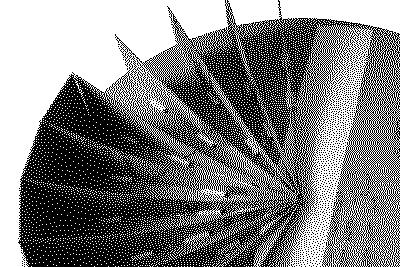
After many hours of gluing and drying, the skeleton of the parabolic dish cooker was complete. Now we lined it with more thin drawing board. We cut the A2 drawing board in a way that it produced eight isosceles triangles without offcut. These triangles were glued to overlap on the skeleton. Die lining was completed with trapezoids which filled up the area between the triangles and the outer edge. They were also glued to overlap eachother.
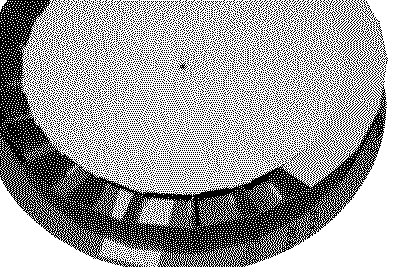
After lining with drawing board, we mirrored the area with reflective foil. The triangles were cut in the same dimensions as from the drawing board but glued with less overlapp which is why we used less reflective foil triangles than drawing board triangles. We mirrored the outer ring with 15 x 15 cm squares instead of trapezoids and simply cut away the excess with a carpet knife.
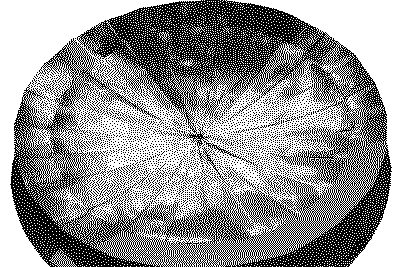
The entire construction took an entire day for two to three people that have built a parabolic mirror like this for the first time.
Test
On the next day we tested the parabolic dish cooker. It was very sunny, a little windy and approximately 15 °C. We conducted our test in the late morning sun. As a cooking place we improvised a tripod out of three knotted metal rods. From these we hung a pot with 1 l cold water. We oriented the parabolic cooker towards the sun and determined the focal point with a piece of cardboard (which gave of smoke after few sekunds in the focal point). At this point we placed the pot so that the base and the lower part of the mantle was in the focal point.
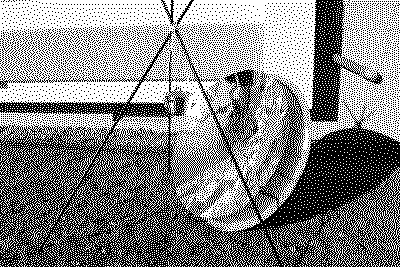
Directly at the focal point the pot turned too hot to touch very quickly but it took a while until this was also the case for the back side. After approximately 30 min we reoriented the parabolic cooker after noticing that the focal point has shifted with the moving sun. The water started to boil after 35 min. We turned the parabolic cooker out of the sun and securely placed the mirrored area against the house wall before we used the water to brew our tea. Now we only had to enjoy our first solar-cooked tea.
Heating 1 L of water by 90 K required 376 kJ. With a solar irradiance of 1 kW/m2 and a duration of 35 min, 2.1 MJ were introduced into our system. This puts us at an efficiency of around 18%.
Conclusion
You definetly need some motivation to craft and a little bit of time but it was easy and affordable to build a relatively powerful parabolic cooker.
35 min to boil a pretty small amount of water is of course not short. It will be hard for a solar cooker to fully compete with conventional stoves but we see room for improvement.
The pot was the smalles one we had, but for such a small amount of water already to big. One should always go for the smalles pot possible so that the minimum amount of energy goes into heating up the pot and the maximum amount into the water.
The mild but constant wind on the day of our test run could also extract more heat from the pot than it was losing anyways. We expect improvement when insulating the pot and the lid, leaving on the bottom uninsulated and focussing the light only there.
Furthermore, we used a silver pot which itself reflects a lot of incoming light. We also expect that a black pot would reduce cooking times. We will report on these optimizations in a future article.
Although we should have known better, some people did not bring snu glasses to the test. It became very clear to us how important a good pair of sunglasses with high SFP is. It is probably also advisable to cover you hands when working close to the focal point or using sunscreen on them. All these easily appliable security measures will probably be especially important when solar cooking is done routinely and frequently.